
Gribbly’s Day Out has joined the workbench. The first goal is a faithful native reconstruction of Andrew Braybrook’s 1985 game for Mac, iPhone and iPad. A separate expanded adventure may follow, but the classic game’s movement and rules need a dependable foundation first.
A playable rescue, with work still to do
The current build lets Gribbly bounce and levitate through the cave landscape, carry Gribblets home and use bubbles against enemies. The enemy lifecycle runs from Seed Pods through Topsies, Chrysalis and Stompers to Fliers, including overturning, capture and rescue behaviour.
Saving at least six of the eight Gribblets is part of the current screen-resolution rules. The build still repeats a practice round rather than progressing through all sixteen original maps. It is a playable reconstruction, not yet an exact recreation.
Letting the original pixels lead
The supplied C64 reference has provided original sprite data, a cave map and the bounce effect. Identifying the sprites properly has been as important as extracting them: early provisional assignments have been replaced with the confirmed frames for Gribbly, the Gribblets and the different enemies.
The bounce sound is rendered from the original SID sound driver in an emulator. It is an isolated rendering of the effect, rather than a recording of someone playing the game. Its timing in the remake and its volume still need listening and playtesting.
Decoding the entrance
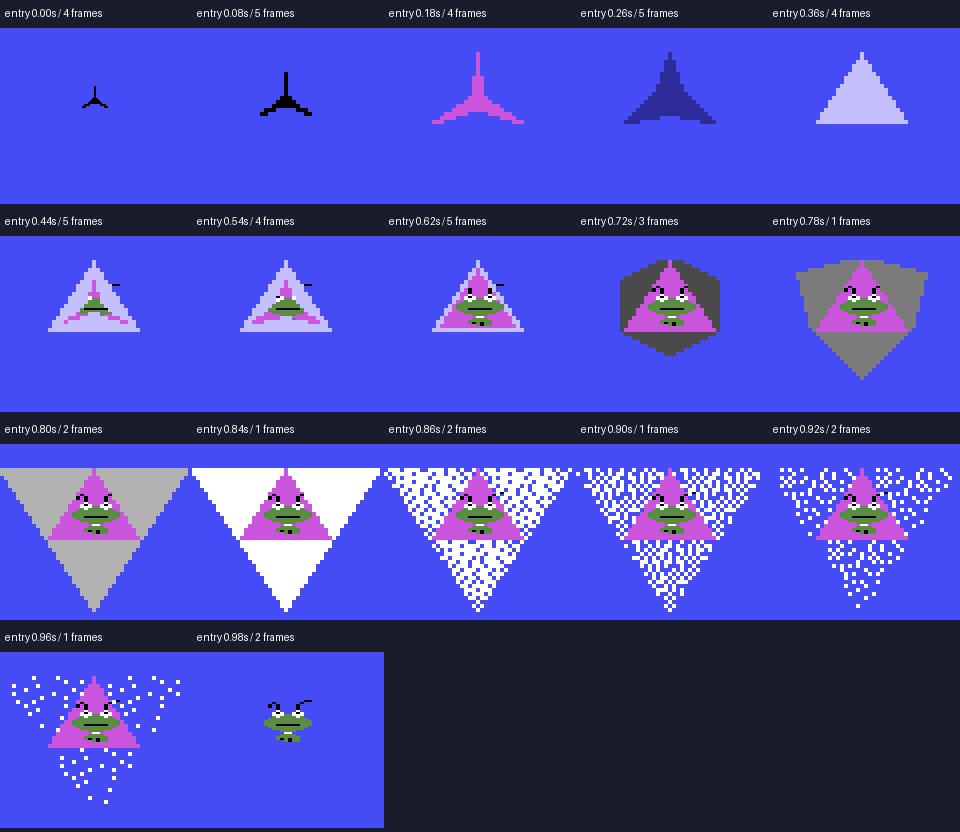
The most revealing piece of work has been Gribbly’s entrance and exit. The first attempt reconstructed the triangular effect from video. Looking at the original code showed why that approximation was difficult to get right: the large outer triangle is assembled from three separately positioned sprites around a central mask and Gribbly.
The remake now replays sprite states captured while executing the original routines in VICE. That preserves their positions, ordering, colour indices and separate horizontal and vertical expansion, including the stippled entrance and the exit’s outward movement.

The decoded timing gives an entrance of 51 PAL frames and an exit of 72: about 1.02 and 1.44 seconds. There are still limits to that match. The capture excludes background game and audio work, the display palette remains the remake’s interpretation, and the original transition sound and pre-exit flashing are not yet reproduced.
Finding the right bounce
Movement has been adjusted so short taps produce smaller hops while sustained movement produces a stronger bounce. The arc is sharper, and Gribbly enters the cave in clear air before gently descending. These changes are still tuning decisions, rather than proof that the original movement has been matched.
Keyboard, touch and compatible gamepad controls are in place. The final judgement on movement and feel comes from playing, so there is still plenty of fine-tuning ahead.
Next comes more comparison with the C64 reference: the remaining maps, movement calibration, enemy timing, palette and sound. The priority is to understand the classic before expanding it.